
NZQA Levels and Credits: What Do Those Numbers Actually Mean?

Following on from last week’s blog about the changes coming to first aid standards, this week I’m getting a little more under the hood.
The course names are staying the same, the minimum training hours are staying the same, but some of the NZQA numbers are changing. And, as with most things involving qualifications frameworks, the numbers sound more mysterious than they really are.
So here’s what NZQA levels and credits actually mean, and what the changes do, and do not, tell you about your first aid training.
The minimum training time for first aid courses is not changing. A Foundation First Aid (FFA) course will continue to have a minimum training time of 8 hours, and the New Zealand First Aid Certificate (NZFA) will continue to have a minimum of 12 hours.
For blended courses, some of that learning is completed online before class. This reduces the face-to-face training time to 4.5 hours for FFA and 8 hours for NZFA.
What do NZQA levels mean?
The level describes the complexity of what the learner is being asked to demonstrate during assessment, not the importance of the outcome.
Using CPR or an AED may save someone’s life, but during assessment the learner is mainly being asked to recognise the situation and correctly follow established procedures and algorithms, such as DRSABCD and the CPR steps. That fits Level 2, where the assessed task is structured and the learner applies known actions to a clearly defined situation.
At Level 3, the assessment expects more judgement and coordination. In Manage first aid during emergency situations, learners are not simply demonstrating one first aid procedure. They must assess what is happening, identify hazards, prioritise more than one casualty, direct bystanders, call for help and adapt their response as the scenario develops.
As the levels increase, so does the complexity of what the learner is expected to demonstrate in the assessment.
At Levels 6 and 7, assessments are more likely to require learners to analyse information, apply specialised knowledge, solve complex or unfamiliar problems, justify decisions and work with a much greater degree of independence.
So a Level 2 standard is not saying CPR is less important than something assessed at Level 7. It is simply describing how complex the assessed performance is and how much judgement and independence the learner must demonstrate.
What do NZQA credits mean?
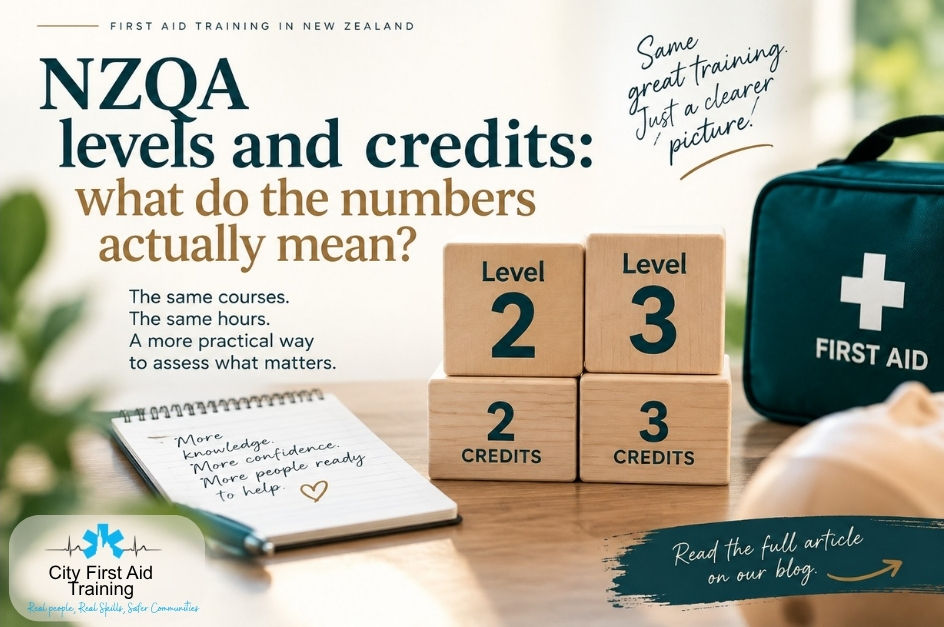
Foundation First Aid is changing from three credits to two, while the New Zealand First Aid Certificate is changing from five credits to three.
Credits represent approximately how much learning, practice and assessment a typical learner needs to meet the standard. One credit represents about ten hours of learning, although that does not mean ten hours in the classroom.
Five credits would represent closer to 50 hours in total. Even allowing for learning and practice outside the classroom, that is far more than the current 12 hours of class time for the New Zealand First Aid Certificate, and we know nobody is asking for more time in the classroom.
For these courses, the lower credit total is a closer reflection of the amount of learning and assessment involved.
It does not mean the skills are less important or that learners are expected to know or demonstrate less. The number has changed. The need to know what to do when somebody genuinely needs help has not.
What happens to the old unit standards?
The old unit standards remain available for assessment until 31 December 2027. Training completed under those standards is still valid, and certificates already awarded do not suddenly become invalid when the transition period ends.
The December 2027 date is simply the final date on which providers can assess learners against the old standards.
A great way to start a new year
City First Aid is changing to the new Skill Standards at the start of 2027.
We’ve completed all the behind-the-scenes compliance work, submitted it to the Education, Health and Community Industry Skills Board, and been approved.
The Education, Health and Community Industry Skills Board is the standard-setting body for first aid. NZQA oversees the national qualifications system, while the ISB develops and maintains the standards and the requirements providers must meet to assess against them. That is why our transition documentation was submitted to the ISB for review.
We were particularly pleased that the reviewer described our submission as “a pleasure to review.”
For us, that was useful external confirmation that our systems, assessment design and supporting evidence were clear, thorough and well aligned with the new standards.
There is a fair amount of work that happens behind the scenes before a provider can simply say, “We’re changing standards.” Most learners will never see any of it, which is exactly as it should be.
The standards may have been given new names and had a bit of a jiggle around, but the purpose of first aid training has not changed.
You should leave more confident and capable of helping when somebody genuinely needs you.
Head of Training | First Aid Educator and Assessment Designer
City First Aid


Comments